

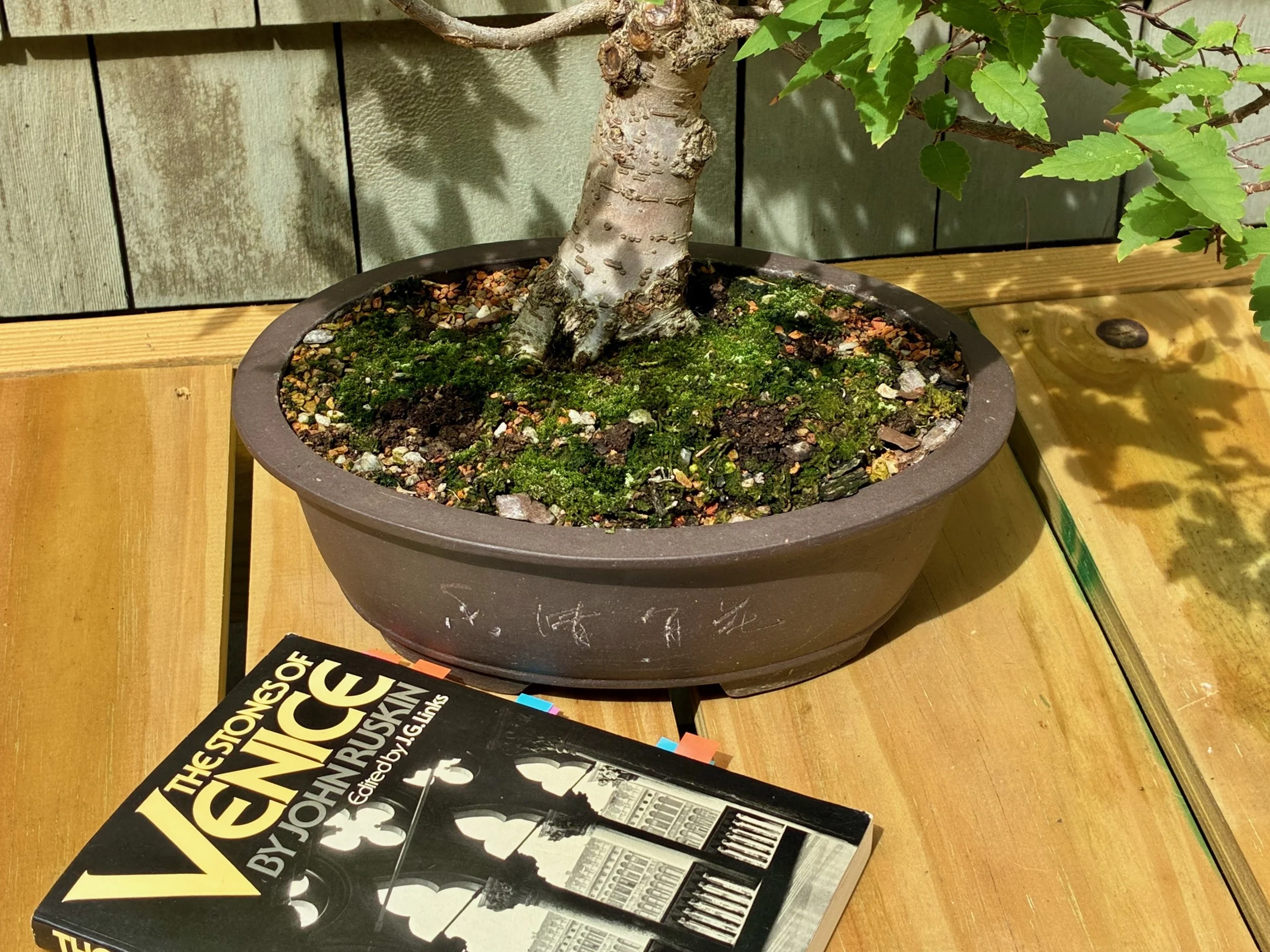
Ruskin with my Zelkova serrata.
I just read The Stones of Venice, by that I mean the J.G. Links abridged 264 page version of that massive 1,200 pp. opus, and consider myself much improved. I even have a new appreciation for bonsai. Come along.
The Stones of Venice, wonderfully written and illustrated by Englishman, John Ruskin, is an analysis of the Gothic architecture found in Venice, Italy. It was published in three volumes over the years 1851-1853 and fits nicely among Ruskin’s other major works on art and society. As an explanatory text it is the clearest, most rewardingly efficient I have ever encountered; as a work of literature among the finest I have read. Ruskin’s clever word choice, along with his many opinions penned as declarations, make it a joy to consume. As an example, note how, beginning with a wall, he deftly leads one to comprehend why architectural support columns are round.
But have we yet arrived at the form which will spare the most room, and use the fewest materials? no; and to get farther we must apply the general principle to our wall, which is equally true in morals and mathematics, that the strength of materials or of men, or of minds, is always the most available when it is applied as closely as possible to a single point.
Now, if every particle of the pier be brought as near as possible to the centre of it, the form it assumes is a circle.
The circle must be, therefore, the best possible form for a pier, from the beginning of time to the end of it. A circular pier is called a pillar or column, and all good architecture adapted to vertical support is made up of pillars, has always been so, and must ever be so, as long as the laws of the universe hold.
See what I mean? In this work, Ruskin leads the reader through his thoughts and thought processes using the finest prose - sublime, at times. To cite another example, the first sentence of what would be Book Two is a triumph by itself. It describes, with mounting excitement, a traveler’s first approach to the city of Venice and contains 222 words, 25 commas, one semicolon, a dash and a period. By comparison with American literature, 1851 was also the year Melville published Moby Dick; Twain’s Adventures of Huckleberry Finn would come a generation later.
Much has been written about the man, John Ruskin (1819-1900), where he is generally described as a “polymath of the Victorian era”. That’s too mild for me. He was a giant. In addition to being the world’s first meaningful art critic, Ruskin was a prodigious author, naturalist, poet, artist, philanthropist, and University of Oxford professor (he taught drawing and what, today, would be called art history). An acolyte of Thomas Carlyle, he was highly influential in his day, helping Victorians understand their art, architecture, and social mores in context with that of earlier periods. Ruskin invariably fixed a hard stance for what he considered to be “true” in any topic studied. He was both controversial and quirky, which may explain his relative anonymity, but he certainly remains important. Ruskin’s many writings and lectures on “the dignity of labor”, and his founding in 1871 of the utopian society Guild of St. George, were fundamental to the subsequent efforts of William Morris (and friends) in starting the Arts and Crafts movement. I could go on.

John Ruskin (self-portrait), contemporaneous with the publication of The Stones of Venice
To get back to the book, The Stones of Venice begins with a stance on what Ruskin claims to be the “virtues of architecture”. This is followed by a breezy description of key structural features (cornice, arch, buttress, etc) and an analysis of how, over time, improvements in these features have adhered to the virtues previously declared. He then spends the bulk of the book going building-by-building, through the venerable structures of Venice to de-construct and, by doing so, critique their architecture. Even in the abridged version this is a mesmerizing journey, glorified by his wonderful prose.

Gothic architectural motifs spotted along the Grand Canal during a visit to Venice in 2015
Sandwiched amid this tour of Venice is a chapter-length essay titled The Nature of Gothic. This ostensible aside is now regarded as one of Ruskin’s masterpieces and has been published subsequently (by William Morris, himself) as a stand alone work. In The Nature of Gothic, Ruskin, the art critic, invents a rubric through which one can assess all Gothic architecture. I will describe that, briefly, and then propose a similar set of rules for appreciating (at last!) the nature of bonsai.
In Ruskin’s breakdown of Gothic architecture he defines six “moral elements” (also referred to as “mental elements” associated with the maker’s state of mind) and asserts that structures exhibit “a greater or lesser degree of Gothicness” by the extent to which they contain or maximize these elements. The elements he lists in order of importance are:
Savageness
Changefulness
Naturalism
Grotesqueness
Rigidity
Redundance
At first these qualities seem strange, but Ruskin convincingly explains his reasoning in text I will leave the interested reader to explore for themselves. It should be recognized, however, that this approach for analyzing architecture is not confined to that field alone and can certainly be applied to other complex systems such as bonsai.
Just as it is challenging to define the essence of Gothic architecture, it is tricky to ascertain exactly what qualities make a potted plant a “bonsai” (literal translation: planted in a container). However, I believe it is possible to use Ruskin’s approach to gain a deeper understanding of the nature of bonsai, and thus capture its quintessence. To begin, I posit the 6 moral elements of bonsai in order of importance, and I made them all A words for your ease of recall:
Accumulation
Abidance
Adaptation
Accord
Aspect
Absence
I will next give a short paragraph on each so that you can follow my intent; but first let me acknowledge a self-awareness:
I am an amateur at the centuries-old practice (devotion) of bonsai. I have read a dozen recent books on the subject, consumed some YouTube, and have nurtured trees in pots that I call “bonsai”. That is my background. I realize that compared to bonsai Masters, past and present, I have little standing. But I do have a brain, and there may be some value in the thoughts of an un-indoctrinated devotee. You can judge.
1. Accumulation
By accumulation I simply mean the appearance of age. However, to use “Age” as an element would be futile, for that is an arithmetically derived value of little significance. Beginners will often inquire about the “age” of a bonsai specimen, but this is merely information and not an aspect of quality. Bonsai artists seek to impart the illusion of age in their trees by nurturing the accumulation of age-signifying features, such as trunk taper, bark character, deadwood and the crucial trait of nebari. Nebari, is a Japanese word referring to the root flare that occurs where a mature tree trunk meets the soil. The presence of an appropriate nebari is perhaps the most critical feature implying “age” in a bonsai. All bonsai must possess the physical traits of age.

The accumulation of age-implying traits in a Japanese hornbeam (Carpinus japonica) bonsai
From: Bonsai, Bachenheimer Resnick, S.M. (1995)
2. Abidance
Every bonsai is a specimen of some naturally occurring plant species (usually a tree) that is grown in a pot rather than the earth. In the wild, plant species grow in a characteristic manner, dictated by their genes, that results in a shape familiar to the observer (e.g., spruce trees are conical). Ruskin noted that one virtue of architecture is that it is a human statement of what a building should be and, by analogy, this virtue is true for bonsai trees. However, it is important that the resulting bonsai form, shaped by human hands, follow the natural tendencies of that species, for to do otherwise would be a charade (cf. unfortunate French poodles). To be sure, bonsai trees are an interpretation of nature, yet they must abide.

Mountainside conifer pictured alongside a hypothetical bonsai representation
From: The Essentials of Bonsai, Shufunotomo Co., Ltd. (1990)
3. Adaptation
Nothing is perfect and neither is Nature. In nature, trees are confined to grow in the surroundings of their germination and, to survive, they must adapt to all occurrences there - happy or harsh. In fact, trees develop character when bearing evidence of adversity; be it persistent wind, rocky soil or simply the routine hazards of a life played out over decades. A tree’s ability to adapt to its circumstance over time is recorded in its form, which bonsaists have categorized into “styles” (e.g., informal upright, slanting, cascade, etc). These hard luck styles are created in a healthy setting by the bonsai artist. Evidence of a tree’s persistence through structural adaptation is particularly appealing to humans.

Japanese white pine (Pinus parviflora) in the informal upright style, representing a tree that tried to grow true while adapting to circumstances along the way.
From: Bonsai, Bachenheimer Resnick, S.M. (1995)
4. Accord
Bonsai trees do not exist in a natural setting; by definition they live in pots. And the ability of a tree to exist in visual harmony with its pot, chosen by the artist, is vital to that bonsai’s appeal. There are many pot “types” out there, and conventions for which pot will best complement both a particular species and style of tree have been developed over time. There are even guidelines for pot dimensions based on tree size, and all of this existing wisdom should factor into what is, ultimately, a very personal artistic decision for the bonsaist. Tree + Pot = Art. The extent of accordance between a pot and tree dominates the artistic statement.

I find this round, fluted, shallow, blue tinted pot to be especially appealing as a complement to the bark, foliage and form of this Japanese maple (Acer palmatum). As with all art, others may disagree.
From: The Essentials of Bonsai, Shufunotomo Co., Ltd. (1990)
5. Aspect
The term aspect has many definitions and I employ a couple of them here. For one, the ideal viewing facet (so-called “front” of the tree) is a critical choice for the bonsaist. It provides the best visual statement of the nebari and trunk, and will dictate subsequent branch selection and trimming. A mature tree in nature has also acquired proper proportional ratios, be they girth (trunk:branch), area (branch:leaf), etc. Straying too far beyond the natural balance here diminishes a bonsai’s appeal.

Beautifully proportioned needle juniper (Juniperus rigida)
From: The Essentials of Bonsai, Shufunotomo Co., Ltd. (1990)
6. Absense
You notice when something should be present but is not. The mind readily recognizes a void and then explores its existence. In the case of bonsai we are talking about branches. The purposeful deselection of branches along a trunk or within the canopy is an important technique in bonsai. Horticulturally, this lets in air and light which contributes to tree health. Artistically, absence invites imagination and brings attention to both form and the finer details likely to be overlooked in the presence of clutter. Creating a pleasing absence is big deal in bonsai design.

Absence of branches along the lower trunk and between canopy layers gives this five-needle pine (Pinus parviflora), trained in the literati style, its allure.
From: Literati Style Penjing, Quingquan, Z. (2015).
There you have it. Six elements, easily remembered, that can be useful the next time you encounter bonsai at a botanical garden, in a book, or on your friend’s patio. In contemplating these six elements one is obliged to appreciate what the bonsai artist has pondered in creating their art. And knowing what to look for enhances both the observation and the pleasure. For example:
Accumulation What signs of maturity are present in this tree?
Abidance Does the form fit or challenge your preconceived notion for this species?
Adaptation What troubles are reflected in the style of this bonsai?
Accord How does the pot choice work for you?
Aspect Is the bonsai proper in all aspects?
Absence Where are the missing branches and what do they reveal?
Try it next time. It may deepen your respect for the bonsai art form. Ideally, as Ruskin suggests, it will “reward the pains of careful examination”. You might even get the urge to grow a tree yourself.
In closing I state, once again, my conviction that reading The Stones of Venice has made me better. By “journeying” to antique Venice I learned to appreciate the all but forgotten Gothic approach to craft, labor and life. As a topic, I hadn’t planned to go that deep into 14th century architecture, but I now carry the potential to become a better writer for having dove and surfaced. And by adopting Ruskin’s approach to understanding a subject, I hope to become a better thinker.
All this makes me wonder whether a new and clearly written book is in order: one that analyzes the strategies, skills and vision of the bonsai artist. Not a book to instruct on technique, but to achieve something better: a deep appreciation of bonsai’s virtues. Such a work might already exist but, if not, I propose it be titled The Trees of Kyoto.
